Showing posts with label Common Whitethroat. Show all posts

Saturday, 28 May 2011

HOME AND AWAY


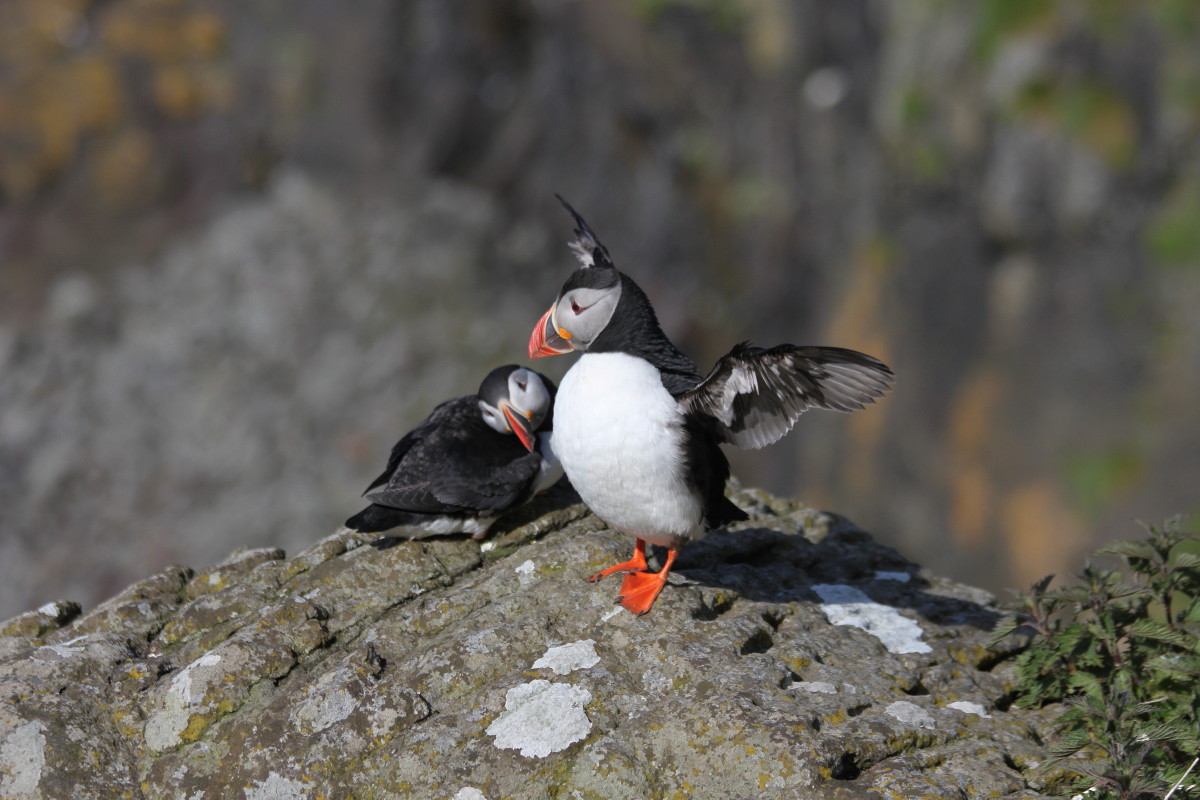
After a challenging couple of weeks on the Isle of Mull, we finally gave up and came home a couple of days early. From a wildlife point of view it was great. We managed to find most of what we wanted to see. The big disappointment, apart from the lack of walking opportunities was being unable to get out to the Puffins and other sea birds on the island of Lunga in the Treshnish Isles. This is definitely one of the highlights of a trip to Mull, but you need the right weather conditions for it really. To make up for it here's a few Puffin pics I took last year.




So, obviously the first thing I wanted to do when we got home was get down to New Hythe, which I did on friday morning. I hurried past the mill for all the usual reasons and made my way along a very quiet Brooklands lake. Apart from some Swifts, Swallows and Martins hawking above, it was pretty much empty. Disappointingly, the tide was very high on the river, so instead of visiting the bucket seat I headed around the sunken marsh. What a difference a couple of weeks makes. The grass verges have grown so high, I couldn't find the path at times. It had rained on thursday and consequently within five minutes my legs were soaked...deja vu!!


The upside was the bird activity, lots of fledglings about and plenty of evidence of other youngsters still in nests. The insect bearing Whitethroat above, nicely dissected by a piece of grass is a poor illustration, never mind, you can see what I mean, especially if you left click. I also saw a few Reed Buntings carrying food for their young within the marsh. Cetti's Warblers were in good voice, as were Nightingales who sang hesitantly at first, but as the morning passed they seemed to become bolder and I saw at least four different birds singing in the relative open and two which chased each other around in a small clearing later in the west scrub area.

A cuckoo was calling from the far side of the marsh and I looked across and saw a bird on the wires which I presumed was the Cuckoo but it turned out to be a Turtle Dove (101). I was pleased to see it because it took me all summer nearly to find one last year.


Abbey Mead was also pretty much deserted, all I really noted was a single Orchid in the SW corner, Common Spotted I think. Because of the low cloud and coolish conditions dragonflies were not seen on the wing and Butterflies were pretty much the same apart from a couple of Speckled Woods and this one pictured below which I think I will say is a male Common Blue, what is it with 'common' stuff being so difficult?


I thought that if it opened it's wings it might make it easier to identify and eventually it did just that and I then saw what a ragged state it was in. I'm not surprised that it looks a bit sad in the picture below, I would too.


I couldn't resist putting a picture up of this well known chap Oedemera Nobilis or more commonly, Fat-legged Beetle or even Thick-kneed Beetle, take your pick. Only the males have the fat legs, very smart they look too.


Also stirred into action by a brief burst of sun were these Longhorn Moths, Nemophora Degeerella. Fascinating little beasts, the males antennae are up to 30cm, three times as long as their body, the females are somewhat shorter. It's the males who get together and perform a little dance on the wing, rising up and down a couple of feet before dropping back to rest on a leaf, and then starting over again. I haven't noticed these before but they are probably quite common and coincidentally Greenie of 'Greenie in the Wild' also featured them on his blog yesterday.
After crossing the railway line I had a quick look on the Railway lake where a Gt Crested Grebe was out in the middle of the lake with four chicks, three were following mum in single file while the other hitched a ride on her back. Cute factor ten out of ten, must try an early visit for a picture sometime soon.

In the trees along the edge of Streamside lake I heard what I thought was a Blackcap singing, luckily I checked it out because it was actually a Garden Warbler (102), my first this year. With Green Woodpecker, four Buzzards, Stock Dove Chiffchaffs, Greenfinches and Pied Wagtail all seen, my list for the morning reached 38 species, not great I know, but it was good to be back.


While we were away our Blue Tit eggs in the camera box hatched and we now have five very hungry chicks as you can see below. Poor old mum and dad are run ragged at the moment but seem to be doing a good job. It's really fascinating having the camera set up but what a time waster, you just can't stop watching them. The picture is actually a photograph of my TV, so they're not disturbed at all by us peeping toms.


Monday, 25 April 2011

HIGH AS A KITE AT NEW HYTHE


New Hythe was absolutely bursting with bird song this morning. Nightingales, Cetti's Warblers, Wrens, Robins, Dunnocks, Chiffchaffs and Common Whitethroats (pictured above), all filled the unseasonally warm, Mayflower scented air with their own individual songs. Spring is well and truly underway, confirmation, as if needed, being my first Hairy Dragonfly of the year. These are the smallest of the Hawkers and this male was the only one I saw today who actually came down to rest, all the others were far too busy patrolling their territories and seeing off intruders.


As I climbed up to the newly christened raptor viewpoint between the sunken marsh and Brooklands lake I heard a Lesser Whitethroat rattling from the undergrowth and after a short wait I was rewarded with a short view of this, the more secretive of the two Whitethroats. I was pleased because this was my 93rd New Hythe species this year. But I was far more pleased with my 94th!


After crossing the railway line I started to turn into the east scrub when I noticed a fairly big bird heading towards me, I thought it was a Marsh Harrier but as it drew nearer I realised that at last, I'd found my first Kent Red Kite, fanatastic! I knew it had to arrive soon and of course getting it at New Hythe is the icing on the cake. To say I was chuffed is an understatement. I fired off a few shots as it headed north over the Railway lake where it was ambushed by a Carrion Crow, there was a brief tussle and the Kite turned and eventually disappeared to the south towards Warren at Pittswood most probably. The shots aren't great, all the usual reasons apply, but as ever a left click on them will help a bit.


After all the excitement I decided that something calming was needed, and what better than a spot of Water Vole watching. Three Water Voles to be precise, all along the same stretch of ditch. The one pictured below was the only one I managed to get a picture of though, he probably thought he couldn't be seen hidden in the reeds having his lunch, but he was wrong.


I checked the east scrub for Grizzled and Dingy Skippers on the way back but couldn't find any, just a few unidentified day flying moths. Four Slow worms were under the refugia and various butterflies including Red Admiral, Peacock, Holly Blue and Orange Tip flew across the scrub without stopping.
There seems to be an abundance of Ladybirds this year, I found these two having a bit of fun but i'm not sure that one of them is a Lady, or the other one come to that!


Some garden news now and we've had a constant stream of Holly Blue butterflies visiting the Pyracantha bush and yesterday I discovered why. They were egg laying, as you can see from the picture below. Apparently Pyracantha is quite commonly used by this species as well as the more usual Ivy, you live and learn. I found the eggs that were laid by this one but they were much too small for me to get a picture of with my camera.


Now for the bad news. I noticed that activity seemed to have stopped in our nest box down the bottom of the garden and when I was mowing the grass down there over the weekend I found out why. One of the pair of Blue Tits had been predated, either by a cat or a Sparrowhawk, just a small pile of feathers on the grass were all that remained. So no fledglings from that box this year unfortunately. What a waste!


As for the camera box, well, the nest was all completed by the pair of Blue Tits who then disappeared for a few days. On friday they were back and the male spent all day displaying to his lady, with flickering wings and fanned tail, how could she resist him. Quite easily it seems, for the last four days he has chased her, sung to her, called to her from the highest tree and wooed her from dawn to dusk. He flies to the nest box and clings to the front looking around anxiously until she finally appears close by and then he dives in the box as if inviting her in to his boudoir. But is she interested? Is she fiddle! She just sits there, ignoring him, while he peers out looking forlorn. It's heartbreaking, I don't know how much longer he can keep it up. There may be trouble ahead!


Monday, 18 April 2011

A STREAK, A SKIPPER, AND A BRIMSTONE MYSTERY


After my visit to the Downs with Greenie in The Wild last week, Carol decided that she too, would like to see an Adder in the wild. So today, with talk of sun and temperatures nudging 20 degrees, surely a recipe for success, we headed for the hills. I wasn't totally surprised to see Greenie's car parked on the roadside verge when we arrived at 09.45. But I was surprised when a quick squint through the bins revealed not just Greenie, but also Ken Browne, alias 'Focusing on Nature'. This was looking like a bloggers convention. A quick call to Ken revealed the surprising news that they hadn't, at that time, found any snakes. But never mind, the morning was still young.


Carol and I had some early success with a single Grass snake, which spotted us at the same time and retreated unhurriedly to the safety of the undergrowth. But from then on, for whatever reason, the snakes didn't want to be seen. We saw a couple of Common Lizards but even they were few and far between. Thankfully, there were plenty of Slow Worms to provide at least some reptilian interest. And of course when our crawling and slithering friends don't play ball, we can always turn to our flying friends. Like the Common Whitethroat pictured at the top of the post.


Just a single Green Hairstreak was seen today, pictured above. This is the smallest of the Hairstreaks and is the first to appear in Spring after overwintering as a chrysalis. At rest, with wings always closed, it's green coloration looks stunning, but in flight they appear drab due to the brown upperwings of both the male and the female. Maybe it was the cool breeze that kept the numbers down, but if it was, it certainly didn't trouble the Brimstones. Like last week, they were plentiful, bright, sulphur yellow males rode the breeze along the hedgerows with presumably just one thing on their minds. Females. Like the one pictured below, who had just one thing on her mind as well, and after some searching, eventually found it. Buckthorn. Having found it, she laid her eggs on it. You can almost see the smile on her face in the second shot. Left click it to see what I mean.


Like Green Hairstreaks, Brimstones never settle with their wings open and keep them closed over their back when they are feeding. The one below is nectaring on what I think are a species of Forget-Me-Not and I really like the way the sun is shining through it's wings and outlining the shape of the abdomen and the overlap of the fore and hindwing.


I followed what I thought was a small day flying moth which eventually landed on the ground for long enough to see that it was actually a Grizzled Skipper. This is the smallest and the earliest of the Skippers and it's seemingly erratic flight is incredibly difficult to follow. I believe Wild Strawberry is one of the caterpillars main food sources and there's lots of it on the Downs so there were probably more around, but like I said, they're not easy to spot.


The last picture is a bit of a mystery. We noticed a Brimstone on the ground in front of us and realised that it was dead. I went to pick it up and saw that there were actually three of them, all together, all in pristine condition, and all dead. Any ideas anyone?


So no Adders for me and Carol today, but a very enjoyable morning anyway and we'll be back in the not too distant future. I'm looking forward to reading how Ken and Greenie's day went, hopefully they did better on the reptile front than me.

Tuesday, 6 July 2010

Dungeness RSPB Tuesday 6th July

I've confessed before about having a weakness for Dungeness. Not just the RSPB reserve but for all things Dungeness. The fishing boats drawn up on the shingle, the old huts and chalets, some of which are converted old railway carriages. The mix of dilapidated outbuildings and newer wooden bungalows, some selling fishing tackle and bait wrapped in newspaper, and others displaying paintings and selling home made arts and crafts from ramshackle outbuildings. The gardens full of weird and wonderful creations made from flotsam and jetson and shells that forever wash up on the pebbles following the Channel storms. I like the old lighthouse whose light would cut through the mist and whose fog horn used to boom eerily like a giant Bittern when I used to fish there through the night on occasions in my youth. And I even like the nuclear power station whose outfall of warm water just off the shoreline which we called 'the boil' attracts the fish who in turn attract the sea birds who in turn attract the birdwatchers.

Dungeness RSPB is where I headed today, once again drawn like a magnet. I soon stopped to watch a couple of Reed Warblers in the reed bed who seemed to be in nest building or repairing mode I think. Or maybe they're building an extension ready for a second brood.


REED WARBLER


While I stood and watched I noticed the Little Egret below working it's way towards me. Stopping occasionally for a lightning stab into the water catching the small fish that were basking in the shallows. I do love their yellow feet, it's like they've stood in the paint pot.

LITTLE EGRET


The early sunshine bought out a few butterflies. I saw my first Painted Lady of the year and also my first two Small Coppers pictured below.


SMALL COPPER


SMALL COPPER
Further along the track I found this fledgling Reed Bunting. It's the first i've seen as young as this but there's no mistaking it. He looks just like his Mum!
JUVENILE REED BUNTING
The Dungeness freshwater fish species this week is a Rudd. A very nice fish which has a flattish head and slightly protruding lower lip which enables it to feed off the surface, sometimes being caught by fly fishermen using dry flies. They don't usually grow much above a couple of pounds., especially given that these shoal fish are preyed upon by Grebes, Egrets and Herons and Terns. Pike and Perch are also very partial.

RUDD

GREY HERON
At the moment every Heron that moves comes under close scrutiny to make sure it isn't one of a certain Purple pair that are currently hogging the limelight. Even the reception of a long flight by a Bittern across the front of Denge Marsh hide hardly caused a ripple while I was in there this afternoon. Most people were much more interested in a fleeting, long distance glimpse of the Purple Heron which lasted two seconds and started the usual was it or wasn't it debate.
No prizes for guessing what's on the menu for the Reed Bunting below's youngsters. I can just hear them now saying 'not green caterpillars again'!


REED BUNTING

WHITETHROAT
As I walked back towards the visitor centre I stopped and listened to quite a loud high pitched buzzing. At first I couldn't tell where it was coming from but then I glanced down and noticed lots of little bees buzzing around my feet. I think they are miner bees because they were going in and out of and digging small burrows in the soil. The picture below shows one doing just that. It seems to have blue eyes but I can find no reference to that characteristic. I will try to ID them and add it to the post later.
Mamy thanks to Rob at Wight Rambles for IDing this Bee for me. Click on the link to visit his blog.


ANTHOPHORA BIMACULATA


And finally.............I saw four Common Lizards on site today. The first three I couldn't photograph because they were too quick and the fourth one I couldn't photograph because it was being carried off by one of the resident Kestrels near the entrance to the reserve. I'm pretty sure it was immediately fed to one of the fledged Kestrels which were sitting on the farmhouse chimney top. Now, what were their names again????


Monday, 7 June 2010

New Hythe Lakes 7th June

I had a very pleasant few hours at New Hythe lakes today and managed to see 43 species of birds which is pretty good by my reckoning, especially as there is so much leaf cover to hide them now.

There were lots of fledglings around, especially Whitethroats and the parents were taking advantage of the thousands of damselflies and other insects which are now appearing all over the site.


WHITETHROAT


I was greeted immediately by a Nightingale which was heard and then seen just off the car park which was a very pleasant way to start. I made the mistake of walking round the sunken marsh path first, the undergrowth, which is now so high and dense was soaking wet after yesterday's rain and I had to wade through it, getting absolutely soaked to the skin in the process. Waterproof trousers will be the order of the day next time. But never mind, I was rewarded with a Lesser Whitethroat, some Reed Buntings and a Gt Spotted Woodpecker among others for my trouble.

Other good sightings included a Garden Warbler singing well and showing nicely down the railway track. A Common Tern gracefully picking insects I believe, from the surface of Streamside lake where a Kingfisher called but wasn't seen. Two Hobby's over Abbey Mead showing off their aerial manoeuvres. A couple of solitary Shelducks on the river, hopefully their other halves were sitting on eggs somewhere close by. And lastly a trio of Jackdaws flying towards the river alongside Brooklands lake. Surprisingly this is a year tick for me at New Hythe, you don't see them too often on the actual site.

Butterflies and dragonflies were noticeable by their absence, a single Holly Blue and a Speckled Wood and a couple of unidentified dragonflies were seen although there were quite a few day flying moths around none of which were in posing mood.


And finally...........


On my post dated 3rd June I showed a picture of a small beetle, Oedemera Nobilis and mentioned that I hadn't found a common name for them. Two bloggers came to my rescue and suggested that it was called Thick-kneed or Fat-legged beetle on account of the male's shapely thighs! Well above are two of the said boys who are possibly playing 'Ring a ring of Roses' I think. So many thanks to Shy Songbird and Rob click on the link to visit their blogs.

Friday, 23 April 2010

New Hythe & Garden 23rd April

HOUSE SPARROW


We had a welcome visit from our local Fox this morning. He likes to sit at the bottom of the garden soaking up the early morning sun, yawning, and having a jolly good scratch. He seems quite at home and doesn't worry too much about the activity within the house, I even opened the patio doors for a clearer shot and he wasn't too bothered, mind you he's a fair distance away and I don't think he would like it if I ventured out on to the patio.


New Hythe was sparkling this morning, the sun was bright and warm and the sky was cloudless. The air was full of birdsong as I started my walk, I think they liked it as much as me although I did refrain from adding my voice to the choir.

First bird on the list was a Cetti's Warbler which flew out of the reeds opposite the fishermans hut at Brooklands where I was trying to get a glimpse of a Sedge Warbler. I wasn't successful but 100 yards further along I heard and then saw my first Reed Warbler of the year. I subsequently heard a few more on the way round.


WHITETHROAT


Whitethroat are now well established for the summer and can be heard singing their scratchy song from every other bush.....nearly. I think they are even more common than the Blackcaps which are abundant here this year.

In and around the Sunken Marsh were two nest building Linnets, and Reed Buntings, Chiffchaffs, Chaffinchs, Cetti's, Blackcaps, Greenfinchs and Wrens were all adding their individual performance to the concert of sound. I arrived at the southern edge of the Marsh for another game of spot the Sedge Warbler which was singing again from the same reedbed as the previous occasions. The only difference on this occasion was that I at last got a fleeting glimpse as he rose to the top a reed stem before presumably seeing me and descending, not to be seen again. Two New Hythe year ticks already. I was on a high, but not for long!

The East Scrub was filled with the rich, mellow and unmistakeable notes of Nightingales singing from every corner, it was like having Nightingale surround sound, Berkeley Square has got nothing on the East Scrub in full flow. Unfortunately I was bought back to earth with a bump when I reached the stream which suffered some kind of pollution last weekend as mentioned in my posting of 19th April. I was hoping the spillage would turn out to be innocuous but my hopes were dashed when I counted at least a dozen dead Eels in the water, a species already seriously under threat, as well as two dead Tench and a dead Pike, this was just a quick look, there must be lots more. Sorry about the gruesome pictures.


EEL


TENCH


PIKE


I managed to find the Ranger, who amazingly was unaware of any wildlife fatalities attributable to the pollution but told me that the Environmental Agency took a sample of the water yesterday and would be acting accordingly. While I was there he phoned his boss to report my findings. This stream was the home of many Water Voles last year and apparently one had been sighted there just before the pollution, even today there were Moorhens on the water feeding on the vegetation, bad news all round I fear.


HERON SNR & JNR & JNR & JNR


The Heronry was busy today, lots of new mouths to feed including the three above, yes there are three. Lets hope they aren't being fed from the aforementioned stream!

The return trip down the river and back to the car park produced among other stuff, seven Shelduck, a Sparrowhawk over which was the only raptor seen, a few Jays , a Stock Dove, a House Sparrow unusually and a Mistle Thrush in it's usual position behind the old Cafe building.

There were also nine species of Butterfly on the wing which were, in no particular order: Small White, Large White, Comma, Speckled Wood, Brimstone, Peacock, Orange Tip, Holly Blue and a Small Tortoiseshell.


SPECKLED WOOD


SMALL TORTOISESHELL


SMALL TORTOISESHELL


ORANGE TIP


ORANGE TIP