Showing posts with label Common Blue. Show all posts

Saturday, 28 May 2011

HOME AND AWAY


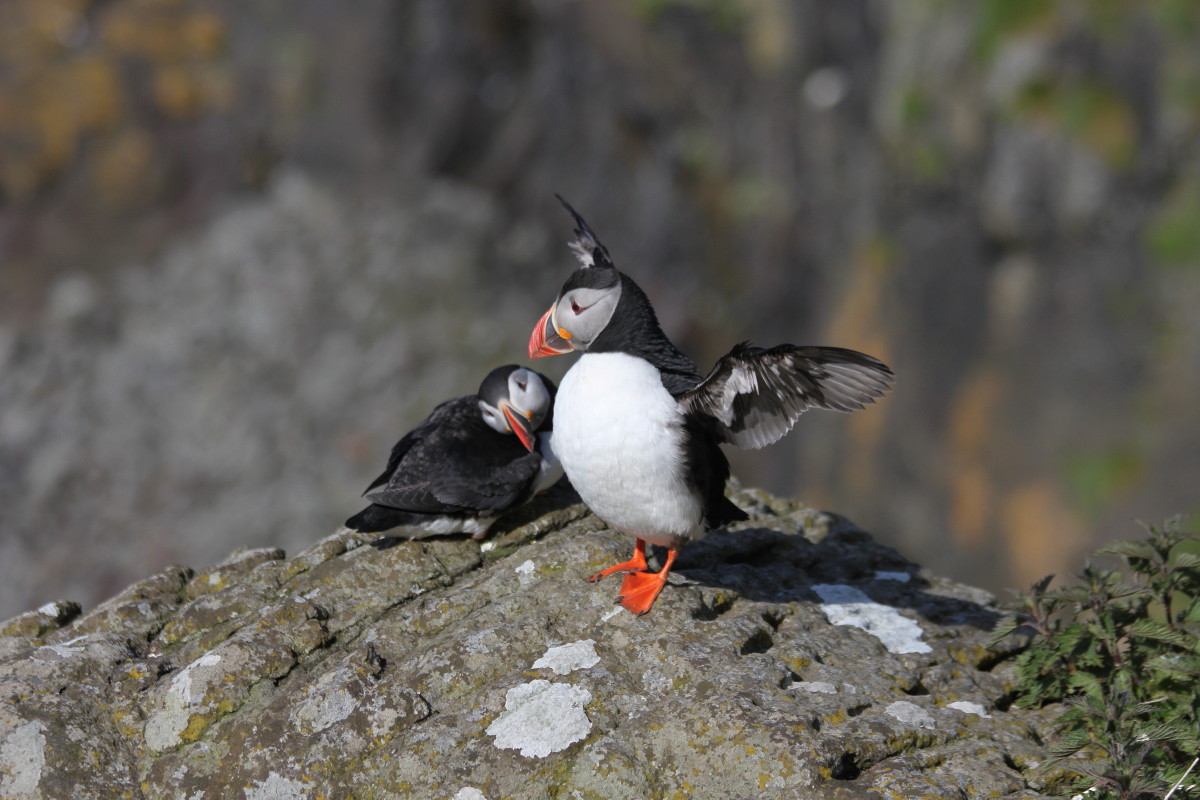
After a challenging couple of weeks on the Isle of Mull, we finally gave up and came home a couple of days early. From a wildlife point of view it was great. We managed to find most of what we wanted to see. The big disappointment, apart from the lack of walking opportunities was being unable to get out to the Puffins and other sea birds on the island of Lunga in the Treshnish Isles. This is definitely one of the highlights of a trip to Mull, but you need the right weather conditions for it really. To make up for it here's a few Puffin pics I took last year.




So, obviously the first thing I wanted to do when we got home was get down to New Hythe, which I did on friday morning. I hurried past the mill for all the usual reasons and made my way along a very quiet Brooklands lake. Apart from some Swifts, Swallows and Martins hawking above, it was pretty much empty. Disappointingly, the tide was very high on the river, so instead of visiting the bucket seat I headed around the sunken marsh. What a difference a couple of weeks makes. The grass verges have grown so high, I couldn't find the path at times. It had rained on thursday and consequently within five minutes my legs were soaked...deja vu!!


The upside was the bird activity, lots of fledglings about and plenty of evidence of other youngsters still in nests. The insect bearing Whitethroat above, nicely dissected by a piece of grass is a poor illustration, never mind, you can see what I mean, especially if you left click. I also saw a few Reed Buntings carrying food for their young within the marsh. Cetti's Warblers were in good voice, as were Nightingales who sang hesitantly at first, but as the morning passed they seemed to become bolder and I saw at least four different birds singing in the relative open and two which chased each other around in a small clearing later in the west scrub area.

A cuckoo was calling from the far side of the marsh and I looked across and saw a bird on the wires which I presumed was the Cuckoo but it turned out to be a Turtle Dove (101). I was pleased to see it because it took me all summer nearly to find one last year.


Abbey Mead was also pretty much deserted, all I really noted was a single Orchid in the SW corner, Common Spotted I think. Because of the low cloud and coolish conditions dragonflies were not seen on the wing and Butterflies were pretty much the same apart from a couple of Speckled Woods and this one pictured below which I think I will say is a male Common Blue, what is it with 'common' stuff being so difficult?


I thought that if it opened it's wings it might make it easier to identify and eventually it did just that and I then saw what a ragged state it was in. I'm not surprised that it looks a bit sad in the picture below, I would too.


I couldn't resist putting a picture up of this well known chap Oedemera Nobilis or more commonly, Fat-legged Beetle or even Thick-kneed Beetle, take your pick. Only the males have the fat legs, very smart they look too.


Also stirred into action by a brief burst of sun were these Longhorn Moths, Nemophora Degeerella. Fascinating little beasts, the males antennae are up to 30cm, three times as long as their body, the females are somewhat shorter. It's the males who get together and perform a little dance on the wing, rising up and down a couple of feet before dropping back to rest on a leaf, and then starting over again. I haven't noticed these before but they are probably quite common and coincidentally Greenie of 'Greenie in the Wild' also featured them on his blog yesterday.
After crossing the railway line I had a quick look on the Railway lake where a Gt Crested Grebe was out in the middle of the lake with four chicks, three were following mum in single file while the other hitched a ride on her back. Cute factor ten out of ten, must try an early visit for a picture sometime soon.

In the trees along the edge of Streamside lake I heard what I thought was a Blackcap singing, luckily I checked it out because it was actually a Garden Warbler (102), my first this year. With Green Woodpecker, four Buzzards, Stock Dove Chiffchaffs, Greenfinches and Pied Wagtail all seen, my list for the morning reached 38 species, not great I know, but it was good to be back.


While we were away our Blue Tit eggs in the camera box hatched and we now have five very hungry chicks as you can see below. Poor old mum and dad are run ragged at the moment but seem to be doing a good job. It's really fascinating having the camera set up but what a time waster, you just can't stop watching them. The picture is actually a photograph of my TV, so they're not disturbed at all by us peeping toms.


Monday, 9 May 2011

DUNGENESS RSPB & RED-BACKED SHRIKE


Alan Roman and I went to one of my favourite places today, Dungeness. We decided to have a quick sea watch first and parked in the car park between the old lighthouse and the Romney. Hythe and Dymchurch railway cafe. It was here that Alan discovered that he had left his binoculars on the kitchen table. Never mind he said, i'll use my scope today, except that he then found that he'd left the fixing plate for his tripod at home. Memory span of a, um, .......what do you call it?


Anyway, the sea watch was a bit quiet, just a couple of GC Grebes, some Common Terns, a small flock of about ten Common Scoters and the usual gull species, so quick march to the RSPB reserve, where we found news of a Red-Backed Shrike over on the ARC site. We gambled that this would stay a while and headed off to see what was on offer.


It was a good day for lizards, with quite a few found basking in the sunny verges, i've chosen this one to show because I like it's slightly green markings. There was little to see from the first couple of hides, just the Shelducks at the top of the post and the usual residents.


But we were accompanied by the constant chatter of Reed Warblers along the lakeside margins, as ever, difficult to see,with just fleeting glimpses like the one above. On the other side of the track we were barracked by a couple of Oystercatchers, below, who had claimed the top of the raised shingle as their own and were intent on repelling trespassers.


There were Common Whitethroats singing and parachuting from just about every bush around the site, so the discovery of a lesser Whitethroat near Christmas Dell hide made a nice change. From the hide we managed to spot a Peregrine, which headed towards the power station, a couple of Pochards and some Common Terns.

Also in this area we found the Four Spotted Chaser below, one of only a couple of dragons seen all day surprisingly.


I was hoping for a Sedge Warbler fest, but I think we were a couple of weeks late for that. Last year, in April, the place was full of them, all singing from the top of the brambles and I got some very nice pictures. Today, all I could manage was the one below, but at least there were some to look at, unlike New Hythe this year.


Considering the weather, butterflies were also hard to come by. We did find a couple on a small patch of Thrift though and i'm going to stick my neck out and say that based on the clear white wing margins, the specimen below is a male Common Blue.........


And of course the next couple are Small Coppers.


There was a female Stonechat on the fence post as we approached the Denge Marsh hide, the only one seen today. It was again quiet inside the hide, apart from the rustle of mine and Alan's crisp packets and sandwich wrappers. In fact it was so loud we nearly didn't hear the Bittern Boom a couple of times. We finally got to see a Marsh Harrier here, a spectacular male, and also the first of three or four Hobby's. No sign of the Purple Heron, which hasn't been seen since friday I believe.

We called in at the lodge on our return to check out the status of the Red-Backed Shrike, but the person we spoke to didn't even know one had been seen, don't they read their own sightings board? While we made some purchases, Alan some seed and me a very nice book entitled British Birds of Prey, a man came in and said he'd just seen a Killdeer, yes, a Killdeer! The lady in the lodge was very upset because she thought he meant road kill, 'and they're such lovely creatures' . We of course went zooming off but feeling understandably pessimistic as all we found was a Little Ringed Plover and a very nice Sandwich Tern, but who knows.

We had more luck though with the Shrike and were lucky enough to see a couple of short sightings of it, albeit through shared binoculars. I think a court martial is in order Mr Roman!


Thursday, 9 September 2010

Dungeness RSPB Thursday 9th Sept


Blue skies and a warm breeze greeted Alan Roman and myself at Dungeness yesterday morning. I wasn't surprised that we ended up logging 48 species of birds during the course of the day but I was surprised at the amount of butterflies on the wing. And given that I didn't manage any decent bird pictures it's just as well there were. Pictured above is one of my favourites, a Small Tortoiseshell.


Hirundines were the most plentiful birds on site today with Swallows and Sand Martins the most numerous and just a few House Martins. A last minute Swift would have been good to see but it didn't happen, A long time now to wait for my next sighting of these enigmatic birds. Although enigmatic was well represented in the shape of a couple of Hobbies who were feasting on an abundant supply of dragonflies, mainly Migrant Hawkers, two of which are pictured below.


The bushes opposite Christmas Dell hide were full of small birds but they were playing hard to get, giving tantalising glimpses but no more. Some of these were Common Whitethroats, Robins, Great Tits and Blue Tits and a singing Cetti's Warbler, but surprisingly the majority appeared to be Reed Warblers even though the habitat seemed a bit incongruous.


The walk between Christmas Dell and Denge Marsh hide produced more butterflies. There were quite a few of what I think (and hope) are Small Heaths, pictured below which i've hardly seen any of this year. Below that is a species i'm more sure of, a Small Copper and one of several seen during the day. This one appears to have just laid an egg.......or is it sitting on a piece of lucky Rabbit poo, or maybe it's dung rolling like the beetles I watched in the Lake District last week, either way it gives a good size comparison!


Kestrel, Little Egret, Grey Heron and a fly over flock of Linnets were added to the bird list before we reached Denge, and before going in the hide we turned left along the track and found the almost resident Great White Egret in the distance, hanging out with three or four more Herons and some Mute Swans. This is without doubt still a great bird to see, but it struck me that a couple of years ago seeing this elegant visitor would have been incredibly exciting, how quickly the excitement fades though when the exotic becomes a bit more familiar.


We retraced our steps back towards the viewing mound and came across the two butterflies shown below. I'm going to stick my neck out and say that they are female Common Blues, time (and a certain butterfly expert) will tell if i'm right but either way the colours are fantastic. The third picture I think is probably a Small Skipper but as above, time will tell!


From the mound we saw Marsh Harriers quartering the reed beds in the distance and also quite a long view of a Bittern flying sedately across the reserve before landing in the reed beds somewhere to the East of Denge hide. We couldn't top that so we made our way back to the visitor centre for lunch. After which we decided on a spot of sea watching in front of the power station at Dungeness beach. This would have been a good idea on a calm day but by now the early breeze was considerably stronger making standing upright difficult and holding a scope or binoculars steady downright impossible! So it was back to the car with just a couple of beachside Wheatears as our only consolation.


Last stop was the ARC site and Hanson hide where it was nice to see good numbers of Pochard, Gadwall, Teal, Mallard and a few Wigeon, signs of things to come I think. Waders were represented by Lapwings, a couple of handsome Black-tailed Godwits, a single Dunlin and another single wader which after a lot of discussion and head scratching, which is a pretty common feature of my bird watching, turned out to be a Little Stint, only the second i've seen. Equally pleasing for me was a Black Tern among the two ot three juvenile Common Terns which danced gracefully up and down above the wind blown lake.
I'll end the post with this picture of a Red Admiral, a reminder of the fading glory of the summer.


Wednesday, 4 August 2010

Elmley Butterflies and New Hythe

As I said in my post yesterday, Elmley was awash with butterflies on monday. In all I counted twelve species assuming the Skippers don't trip me up!


COMMON BLUE


The Common Blues lived up to their name and were seen (and followed) at regular intervals during my walk.

GATEKEEPER


GATEKEEPERS


For sheer numbers the Gatekeepers won hands down. I wouldn't say there were swarms of them but if you put them all together you would have had a fair sized cloud.


SMALL TORTOISESHELL


This seems to have been a good year for Small Tortoiseshells, last year I saw nowhere near the number that i've seen this year at various sites in Kent & Sussex.


SIX SPOT BURNET, SMALL SKIPPER & UFO


I know the Burnets are moths not butterflies but they look nice so i've included them. I seem to be seeing more 6 spots about now where as earlier in the summer the 5 spot seemed more prolific.


COUNT THE BUTTERFLIES


On the approach to the third hide there were four or five of the large plants pictured above which I think are Greater Burdock, and there were maybe 100 butterflies on and around them. I don't think i've ever seen so many butterflies in one small area. It was quite something walking past and seeing them all lift off and then quickly settle again.


SMALL SKIPPER


Skippers were another species that were well represented. I think they were mostly Smalls but I guess Essex and Large could also have been present, it's so difficult to tell, especially when they're on the wing.


Many thanks to Greenie (click on the link to visit his blog) for pointing out that the Skippers are probably the Essex variety, which i'm happy to take his word for. And also that the plant below is indeed Sea Lavender.
SMALL COPPERS


Two Small Coppers at the same time! How good is that? I don't know what the plant is in the picture above and the one below but whatever it is the butterflies absolutely loved it. There were only three of these lovely little plants just as you come to the tall hide on the right by the sea wall but I wish there had been more.


BROWN ARGUS


The same plant was also very attractive to the Brown Argus there were three here and that was the only place I saw this species. It's easy to see how they are mistaken for Common Blues when their wings are closed.


COMMON BLUE


Yes, I know i've already featured Common Blues but I liked this picture and it does highlight the difference with the Brown Argus.


BROWN ARGUS AND COMMON BLUE


Just for good measure here's a shot of the two of them together with their wings open.


And finally...........................I had a quick hour down at the Sunken Marsh this morning in a last ditch attempt to add the very elusive Turtle Dove to my New Hythe year list and yippee, there it was sitting on the wires waiting for me! All things come to those who wait and persevere. Shame about the photo though, in my haste to record the occasion before it flew off never to be seen again, I failed to check the camera settings, hence the odd exposure.


TURTLE DOVE


Monday, 19 July 2010

New Hythe lakes Monday 19th July

I didn't realise just how hot it was going to get as I left Brooklands car park at New Hythe lakes at about 09.15 this morning. At that time it was pleasantly warm and the sky was dark blue with streaks of high white summer cloud. I couldn't help but feel optimistic and within minutes my optimism was rewarded with a picture of an Emperor Dragonfly. This is apparently Britain's largest dragonfly and I believe this one is either a female or an immature specimen. Either way i'm pleased to have got a picture at last because they're just amazing creatures.


EMPEROR DRAGONFLY


I finally managed to beat my way through the vegetation and get around the Sunken Marsh footpath. It was a falling tide on the river but still high and all that it offered were the usual Gulls, Mute Swans, a couple of Canada Geese and the family of Shelducks on the far bank out of camera range. The riverside reedbeds still concealed the ever singing Reed Warblers, do they ever stop? While overhead a few loose parties of Swifts were seen heading South. I'm not sure if this is the beginning of the end of their stay with us. I think the main migration is through August but either way i'll be sad to see them go, more so than any other of our summer migrants I think.

On the water I could only find the usual Coots and Tufties on the Railway lake along with a couple of Great Crested Grebes with their fast growing stripey young, too big now I think for a ride on Mum's back, or maybe not!

One of the few bird photo opportunities was this young Blue Tit flitting through the undergrowth and occasionally hanging upside down to get at whatever tasty morsel it had found lurking in the seed heads.


BLUE TIT


On the opposite side of the path this Red-tailed Bumblebee was finding something completely different and more to his own liking in the Thistle heads. The East Scrub was very quiet, the near silence only broken by the Yaffle of a Green Woodpecker, which I didn't see. A quick look at what remains of the refugia laid down for the local Reptiles revealed just one Slow worm. I couldn't help but wonder where all the Common Lizards are on the New Hythe site this year, I've barely seen one yet. My worries about the Water Voles which I expressed through the Autumn and the Winter last year were also seemingly justified as there have been very few sightings this summer compared with last year when you could often see three or four along the same water filled ditch. I hope this is just a natural downturn for both of these species and that they both bounce back next year but i'm not so sure. Now, where did I put that optimism I had at the start of this post?


RED-TAILED BUMBLEBEE


As I said at the beginning, I didn't know just how hot it was going to be and now at about 11.00am I was beginning to realise as the temperature seemed to soar. I was at the furthest point of the walk and was just about to retrace my steps when I bumped into Den & Doreen. Three pairs of eyes now so hopefully we might find some more goodies on the way back.


I'm afraid it's butterfly time again. But i've tried to put pictures up of different species which I haven't photographed here for a while. Like this Common Blue below which just would not open up and reveal what it was named for. Mind you the underwing is pretty good as well really.


COMMON BLUE


Next up along the southern side of Abbey Mead lake we found this Holly Blue recognisable from the Common by the lack of orange spots on the underwing. Again not allowing a view of it's blue upperwings.


HOLLY BLUE


And lastly just a bit further along was this Brimstone, this is a female I think being more of a green than the bright yellow male. This species always rests with it's wings closed, maybe that's to make it look like a leaf, which it does.

BRIMSTONE


On the sunnyside of the path as it drops down towards the river we couldn't help but notice this lone Pyramidal Orchid, below. First time i've seen one here, seems like it maybe a good year for these.


PYRAMIDAL ORCHID


Back along the river path and apart from the odd Greenfinch, a few Whitethroats and a Moorhen hitching a ride downstream on the receding tide aboard a raft of reeds all was very quiet in the midday sun. But I did manage a couple of photos of a juvenile Grey Heron practicing his fishing skills. Or was he just standing in the water to keep his feet cool?


GREY HERON


AND AGAIN


And finally.................As we walked on the wide track at the bottom of the mound between the marsh and Brooklands lake a tiny Common Lizard ran across the path in front of us. Optimism restored!