
The weather forecast for wednesday was for gale force winds, rain and hail, add this to 9 degrees centigrade and you have uncomfortable conditions for walking. So we decided to head for the forestry commission area close to Glengorm castle, pictured below, in the hope that it would afford some shelter. But it didn't. The heavens opened as we arrived, so we took cover in the cafe until it eased. I don't know about you, but I don't mind too much if it starts raining during the walk, but I absolutely hate it when it's chucking it down as i'm putting my boots and stuff on. Guaranteed to make me grumpy.

Not only did the forest fail to provide much cover from the elements but it failed to provide much in the way of wildlife too really. Although to be fair, you couldn't really expect too much given the conditions. We were treated to an aerial display from three Buzzards soon after setting off, they didn't seem to mind the wind, and the rain was holding off at that time. A couple of Cuckoos also put in an appearance, there seems to be a lot of these up here. I'm not sure what their preferred host birds are, Meadow Pipits and Dunnocks possibly, there are no Reed Warblers on the island, although Sedge Warblers aren't too uncommon. Magpies and Jays are as rare as hen's teeth too. A situation that some would be pleased to have on the mainland no doubt.

On the other hand, there are quite a few of the above, Hooded Crows, they are a handsome bird with their black bib and grey body, which I hope to get a better shot of during my stay here. It's these chaps who are the self proclaimed sheriffs of the skies here, they're usually first on the scene when a big, bad, bird of prey needs chasing out of town.
We saw a sign which said 'shore walk', so we changed our planned route and headed for the rocky coastline, it was then that the proper rain started. To make matters worse we were hungry for lunch, but the thought of rain sodden sarnies wasn't appealing, we'd tried them earlier in the week at Loch Frisa and didn't like them at all. We needed a miracle. And there it was, perched on a small piece of level ground, just 50 yards from a rocky, kelp lined inlet was................a bird watching hide!! It was unlocked and empty, and the roof didn't leak. The funny thing is, we've done this walk before, in the last five years or so and we hadn't seen it. But it was, according to the brass plaque above the door, erected in 1996. Anyway, a leisurely lunch was eaten in the dry, during which time Carol spotted a familiar shape gliding across the inlet, an Otter! I wouldn't have been surprised to look out and see a rainbow with bluebirds flying over it at that point.

I didn't of course, but I did see one of the many Oystercatchers on the rocks close by, who was happy to let me photograph him while he shook the rain off his back.
 He shouldn't have bothered, it was soon back again. The walk back was long and quite arduous, punctuated by Coal Tits and Bullfinches and hailstones which stung our faces and bounced off the track like jumping beans.
Let there be light!! At last, a brighter day. Even though the sound of rain outside had me burying my head in the pillows in desperation this morning, it soon passed. Our short drive to Langamull this morning was in sunlight and spirits and hopes were high. A short piece of forest walking, which has in the past produced some nice sightings of Crossbills, soon gives way to the most beautiful, unspoilt coastal meadow and white, sandy, rocky beach. If you haven't been to the NW highlands and islands of Scotland you would probably think I was exaggerating when I say that the white sand and sparkling blue sea, on a sunny day, are reminiscent of the Mediterranean. Trust me they are, but thankfully what is missing are the crowds.

The burst of sun also bought out a dragon, just one, but it was worth it when it turned out to be a superb Four Spotted Chaser which thankfully settled, at last, before I stumbled over the edge of the cliffs in hot pursuit. This is only the second dragon of the week, the first remaining anonymous. The sun also tempted the first butterflies on to the wing, with Speckled Wood and Green-Veined white making an appearance.
 I managed to get a picture of sorts of one of the many Wheatears along the coast but they were very flighty and seemed to know exactly the distance required between camera and subject to make a poor shot even poorer.

We stopped for lunch at a particularly scenic spot and noticed an Oystercatcher sitting about twenty yards away on a really exposed outcrop of grass topped rock. It seemed quite relaxed with our presence, unusually for this highly strung species, but it flew away noisily as we walked past later and noticed the 'nest' and eggs pictured above. With all this wilderness she had chosen a spot right alongside the footpath, albeit a quiet one.
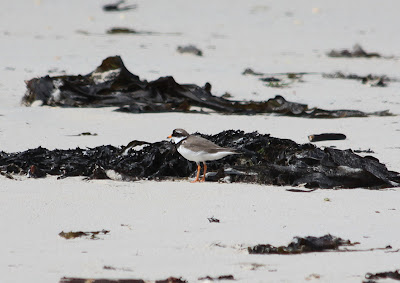 Before we left the white sand beach we saw a pair of Ringed Plovers who had a little ball of feathers on legs in tow. I would have loved to get a picture of it but didn't want to risk upsetting them. I guess life is tough enough for them without me interfering.

The last port of call on our route was the tiny fishing harbour of Croig, quaint, quiet and quintessentially Scottish, this is a gem of a place. A couple of houses, a couple of fishing boats, a couple of lobster pots, some Herons, some Redshanks, some Curlew and some Seals, common I think. I'd tell you more but I don't want you all going there I want to keep it all to myself.


I didn't of course, but I did see one of the many Oystercatchers on the rocks close by, who was happy to let me photograph him while he shook the rain off his back.
 He shouldn't have bothered, it was soon back again. The walk back was long and quite arduous, punctuated by Coal Tits and Bullfinches and hailstones which stung our faces and bounced off the track like jumping beans.
Let there be light!! At last, a brighter day. Even though the sound of rain outside had me burying my head in the pillows in desperation this morning, it soon passed. Our short drive to Langamull this morning was in sunlight and spirits and hopes were high. A short piece of forest walking, which has in the past produced some nice sightings of Crossbills, soon gives way to the most beautiful, unspoilt coastal meadow and white, sandy, rocky beach. If you haven't been to the NW highlands and islands of Scotland you would probably think I was exaggerating when I say that the white sand and sparkling blue sea, on a sunny day, are reminiscent of the Mediterranean. Trust me they are, but thankfully what is missing are the crowds.
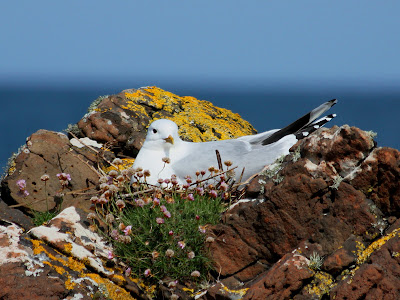
Wheatears, Meadow Pipits, Sandpipers, Ringed Plovers, Oystercatchers, Common Gulls, one pictured above on her nest, Shags, a couple of Great Northern Divers in summer plumage, spectacular diving Gannets and oh so elegant Terns had the place to themselves, apart from me and Carol of course.

The burst of sun also bought out a dragon, just one, but it was worth it when it turned out to be a superb Four Spotted Chaser which thankfully settled, at last, before I stumbled over the edge of the cliffs in hot pursuit. This is only the second dragon of the week, the first remaining anonymous. The sun also tempted the first butterflies on to the wing, with Speckled Wood and Green-Veined white making an appearance.
 I managed to get a picture of sorts of one of the many Wheatears along the coast but they were very flighty and seemed to know exactly the distance required between camera and subject to make a poor shot even poorer.
We stopped for lunch at a particularly scenic spot and noticed an Oystercatcher sitting about twenty yards away on a really exposed outcrop of grass topped rock. It seemed quite relaxed with our presence, unusually for this highly strung species, but it flew away noisily as we walked past later and noticed the 'nest' and eggs pictured above. With all this wilderness she had chosen a spot right alongside the footpath, albeit a quiet one.
 Before we left the white sand beach we saw a pair of Ringed Plovers who had a little ball of feathers on legs in tow. I would have loved to get a picture of it but didn't want to risk upsetting them. I guess life is tough enough for them without me interfering.
The last port of call on our route was the tiny fishing harbour of Croig, quaint, quiet and quintessentially Scottish, this is a gem of a place. A couple of houses, a couple of fishing boats, a couple of lobster pots, some Herons, some Redshanks, some Curlew and some Seals, common I think. I'd tell you more but I don't want you all going there I want to keep it all to myself.


