Showing posts with label Oystercatcher. Show all posts

Thursday, 19 May 2011

ISLE OF MULL THURSDAY 19TH MAY


The weather forecast for wednesday was for gale force winds, rain and hail, add this to 9 degrees centigrade and you have uncomfortable conditions for walking. So we decided to head for the forestry commission area close to Glengorm castle, pictured below, in the hope that it would afford some shelter. But it didn't. The heavens opened as we arrived, so we took cover in the cafe until it eased. I don't know about you, but I don't mind too much if it starts raining during the walk, but I absolutely hate it when it's chucking it down as i'm putting my boots and stuff on. Guaranteed to make me grumpy.


Not only did the forest fail to provide much cover from the elements but it failed to provide much in the way of wildlife too really. Although to be fair, you couldn't really expect too much given the conditions. We were treated to an aerial display from three Buzzards soon after setting off, they didn't seem to mind the wind, and the rain was holding off at that time. A couple of Cuckoos also put in an appearance, there seems to be a lot of these up here. I'm not sure what their preferred host birds are, Meadow Pipits and Dunnocks possibly, there are no Reed Warblers on the island, although Sedge Warblers aren't too uncommon. Magpies and Jays are as rare as hen's teeth too. A situation that some would be pleased to have on the mainland no doubt.


On the other hand, there are quite a few of the above, Hooded Crows, they are a handsome bird with their black bib and grey body, which I hope to get a better shot of during my stay here. It's these chaps who are the self proclaimed sheriffs of the skies here, they're usually first on the scene when a big, bad, bird of prey needs chasing out of town.


We saw a sign which said 'shore walk', so we changed our planned route and headed for the rocky coastline, it was then that the proper rain started. To make matters worse we were hungry for lunch, but the thought of rain sodden sarnies wasn't appealing, we'd tried them earlier in the week at Loch Frisa and didn't like them at all. We needed a miracle. And there it was, perched on a small piece of level ground, just 50 yards from a rocky, kelp lined inlet was................a bird watching hide!! It was unlocked and empty, and the roof didn't leak. The funny thing is, we've done this walk before, in the last five years or so and we hadn't seen it. But it was, according to the brass plaque above the door, erected in 1996. Anyway, a leisurely lunch was eaten in the dry, during which time Carol spotted a familiar shape gliding across the inlet, an Otter! I wouldn't have been surprised to look out and see a rainbow with bluebirds flying over it at that point.


I didn't of course, but I did see one of the many Oystercatchers on the rocks close by, who was happy to let me photograph him while he shook the rain off his back.


He shouldn't have bothered, it was soon back again. The walk back was long and quite arduous, punctuated by Coal Tits and Bullfinches and hailstones which stung our faces and bounced off the track like jumping beans.


Let there be light!! At last, a brighter day. Even though the sound of rain outside had me burying my head in the pillows in desperation this morning, it soon passed. Our short drive to Langamull this morning was in sunlight and spirits and hopes were high. A short piece of forest walking, which has in the past produced some nice sightings of Crossbills, soon gives way to the most beautiful, unspoilt coastal meadow and white, sandy, rocky beach. If you haven't been to the NW highlands and islands of Scotland you would probably think I was exaggerating when I say that the white sand and sparkling blue sea, on a sunny day, are reminiscent of the Mediterranean. Trust me they are, but thankfully what is missing are the crowds.


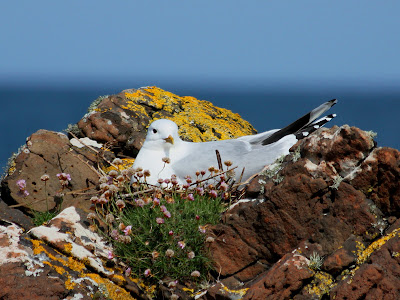
Wheatears, Meadow Pipits, Sandpipers, Ringed Plovers, Oystercatchers, Common Gulls, one pictured above on her nest, Shags, a couple of Great Northern Divers in summer plumage, spectacular diving Gannets and oh so elegant Terns had the place to themselves, apart from me and Carol of course.


The burst of sun also bought out a dragon, just one, but it was worth it when it turned out to be a superb Four Spotted Chaser which thankfully settled, at last, before I stumbled over the edge of the cliffs in hot pursuit. This is only the second dragon of the week, the first remaining anonymous. The sun also tempted the first butterflies on to the wing, with Speckled Wood and Green-Veined white making an appearance.


I managed to get a picture of sorts of one of the many Wheatears along the coast but they were very flighty and seemed to know exactly the distance required between camera and subject to make a poor shot even poorer.


We stopped for lunch at a particularly scenic spot and noticed an Oystercatcher sitting about twenty yards away on a really exposed outcrop of grass topped rock. It seemed quite relaxed with our presence, unusually for this highly strung species, but it flew away noisily as we walked past later and noticed the 'nest' and eggs pictured above. With all this wilderness she had chosen a spot right alongside the footpath, albeit a quiet one.
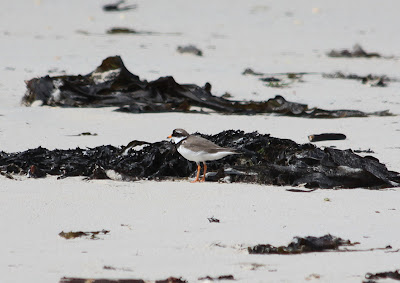


Before we left the white sand beach we saw a pair of Ringed Plovers who had a little ball of feathers on legs in tow. I would have loved to get a picture of it but didn't want to risk upsetting them. I guess life is tough enough for them without me interfering.


The last port of call on our route was the tiny fishing harbour of Croig, quaint, quiet and quintessentially Scottish, this is a gem of a place. A couple of houses, a couple of fishing boats, a couple of lobster pots, some Herons, some Redshanks, some Curlew and some Seals, common I think. I'd tell you more but I don't want you all going there I want to keep it all to myself.


Monday, 9 May 2011

DUNGENESS RSPB & RED-BACKED SHRIKE


Alan Roman and I went to one of my favourite places today, Dungeness. We decided to have a quick sea watch first and parked in the car park between the old lighthouse and the Romney. Hythe and Dymchurch railway cafe. It was here that Alan discovered that he had left his binoculars on the kitchen table. Never mind he said, i'll use my scope today, except that he then found that he'd left the fixing plate for his tripod at home. Memory span of a, um, .......what do you call it?


Anyway, the sea watch was a bit quiet, just a couple of GC Grebes, some Common Terns, a small flock of about ten Common Scoters and the usual gull species, so quick march to the RSPB reserve, where we found news of a Red-Backed Shrike over on the ARC site. We gambled that this would stay a while and headed off to see what was on offer.


It was a good day for lizards, with quite a few found basking in the sunny verges, i've chosen this one to show because I like it's slightly green markings. There was little to see from the first couple of hides, just the Shelducks at the top of the post and the usual residents.


But we were accompanied by the constant chatter of Reed Warblers along the lakeside margins, as ever, difficult to see,with just fleeting glimpses like the one above. On the other side of the track we were barracked by a couple of Oystercatchers, below, who had claimed the top of the raised shingle as their own and were intent on repelling trespassers.


There were Common Whitethroats singing and parachuting from just about every bush around the site, so the discovery of a lesser Whitethroat near Christmas Dell hide made a nice change. From the hide we managed to spot a Peregrine, which headed towards the power station, a couple of Pochards and some Common Terns.

Also in this area we found the Four Spotted Chaser below, one of only a couple of dragons seen all day surprisingly.


I was hoping for a Sedge Warbler fest, but I think we were a couple of weeks late for that. Last year, in April, the place was full of them, all singing from the top of the brambles and I got some very nice pictures. Today, all I could manage was the one below, but at least there were some to look at, unlike New Hythe this year.


Considering the weather, butterflies were also hard to come by. We did find a couple on a small patch of Thrift though and i'm going to stick my neck out and say that based on the clear white wing margins, the specimen below is a male Common Blue.........


And of course the next couple are Small Coppers.


There was a female Stonechat on the fence post as we approached the Denge Marsh hide, the only one seen today. It was again quiet inside the hide, apart from the rustle of mine and Alan's crisp packets and sandwich wrappers. In fact it was so loud we nearly didn't hear the Bittern Boom a couple of times. We finally got to see a Marsh Harrier here, a spectacular male, and also the first of three or four Hobby's. No sign of the Purple Heron, which hasn't been seen since friday I believe.

We called in at the lodge on our return to check out the status of the Red-Backed Shrike, but the person we spoke to didn't even know one had been seen, don't they read their own sightings board? While we made some purchases, Alan some seed and me a very nice book entitled British Birds of Prey, a man came in and said he'd just seen a Killdeer, yes, a Killdeer! The lady in the lodge was very upset because she thought he meant road kill, 'and they're such lovely creatures' . We of course went zooming off but feeling understandably pessimistic as all we found was a Little Ringed Plover and a very nice Sandwich Tern, but who knows.

We had more luck though with the Shrike and were lucky enough to see a couple of short sightings of it, albeit through shared binoculars. I think a court martial is in order Mr Roman!


Wednesday, 30 June 2010

A Harty walk

There's a nice walk around Harty on the Isle of Sheppey that Carol and I like to do occasionally, it's about 8 miles long and there's a nice pub about halfway round. Given the weather forecast, today seemed like a good day to do it and we were right.
After parking at Leysdown-on-Sea we were soon heading inland along a farm track accompanied by the local Kestrel first of all and then by a pair of Marsh Harriers quartering the adjoining fields. We didn't object at all to the extra company.


BROWN HARE
At first the Brown Hare above seemed quite pleased to see us, even posing for the prerequisite photo. However, as the next picture shows, as soon as that was completed he decided enough was enough. I believe the technical term is 'showing a clean pair of heels'.
The terrain is pretty flat here, there's not much need for a Sheppey Mountain Rescue team if you get my drift, so the wind can be quite strong, as it was at times today. I mention this for a reason, as we walked on we noticed ever increasing numbers of small dragonflies along the path sheltering on the lee side of the hedgerow, there were literally hundreds of them, more than i've ever seen anywhere before. I took a couple of pictures but it was difficult as wherever they landed they were swaying in the wind making focussing difficult. I've looked in my books and can only assume, judging by their size that they are Common Darters. I await the verdict of my peers, who will also be needed at least once more, probably twice later on.....................!


COMMON DARTER
Some way further along we had our first encounter of the human kind. Nothing unusual in that I hear you say. And you're right, except that it turned out to be in the shape of Derek Faulkner of
Letters from Sheppey fame, click on his name to look at his blog. Apart from Derek we saw one other person on our travels, how good is that?
After the obligatory stop at the excellent Harty Ferry Inn we headed for the path on the top of the flood wall that winds it's way along the marshy, desolate, bird filled shoreline of the Swale. This is the Swale Nature Reserve that Derek is a warden for and very nice it is too, apart from the fact that it's a bit overgrown at the moment and the grass is very long. That's not really a problem except that we had both got our legs out today so they were at the mercy of every stinging nettle, thistle and biting insect, not to mention the terrifying prospect of one of the millions of Grasshoppers trespassing on 'private property'!
Sedge and Reed Warblers, Skylarks, Harriers, Shelduck, Greylags, Reed Buntings, Oystercatchers, Little Egrets and Grey Herons were just some of the species seen along the track. Bearded Tits were also heard, but only the shortest glimpse was had, mainly due to the strong breeze I suspect.


MALE MARSH HARRIER
The butterflies were really struggling here, again mainly due to the wind. Meadow Browns were I think the main species but I did find this Green Veined White sheltering in the grass.

GREEN VEINED WHITE
Also around in good numbers were what I think are Small Skippers (below) but again i'm happy to be corrected. A more open winged shot would have helped but it wasn't to be.


SMALL SKIPPER

Another one who wouldn't open his wings is the little chap below. I'm really confused with this one, it was very small and first I thought Gatekeeper but i'm not so sure now, in fact i'm veering towards Small Heath but who knows? Seriously, who knows?!


Since we're on the subject of butterflies, I thought I'd show you this picture of a Peacock........! It was wandering about in Harty churchyard and no Warren, I won't be adding it to my Kent list!
PEACOCK

And finally.....................I couldn't resist this Oystercatcher, just asking to be photographed, along the sea wall at Leysdown on our return.
OYSTERCATCHER


Wednesday, 26 May 2010

Magical Mull

SISKIN


RED DEER
CHAFFINCH
We have been going to the Isle of Mull for about five years now. It's never failed to charm, captivate and excite us and this year was no exception. We stayed once again in the lovely hamlet of Dervaig in a superb house situated about thirty feet from a large reedbed dissected by a small river and with views to the hills from the front and the head of Loch Cuin to the side. This of course makes it a fabulous spot to watch the birds and other wildlife almost twenty four hours a day as the nights hardly get further than dusk at this time of the year. Some of the more common visitors to the area were Siskins and Chaffinches (above), but more unusual was the Grasshopper Warbler (below) which 'reeled' in the bushes just in front of the house on our first evening and for several evenings after. The picture was taken at about nine in the evening so not too great but this was a first for me and i'm pleased to get any picture of one of these fascinating birds.


GRASSHOPPER WARBLER


Soon after the excitement of the Grasshopper Warbler we had one of many visits from Red Deer. The one below was a particularly fine example who was happy to let me take his picture from the balcony of the house not fifty feet away. Again the photo is not great due to the light, it was now about 10pm so I had to push the ISO on the camera very high.


OYSTERCATCHER


RINGED PLOVER

I think the Gull above is a Common Gull, she was sitting on eggs on a small rocky outcrop and wasn't too disturbed by us stopping to picture her.

HERRING GULL (I THINK)


Thankfully the weather was pretty kind to us so we were able to take a trip to the Treshnish Islands to the West of Mull. Heading out from the tiny port of Ulva our first stop was Staffa, home of Fingal's Cave and inspiration for Mendelssohn's Hebridean Overture I believe and the amazing basalt columns known as the Colonnade or Great Face.


Next stop after Staffa was the island of Lunga, home to thousands of sea birds including Guillemots, Razorbills, Shags and that most photogenic of birds the Puffin, which return to the islands from their winter home on the sea in March and April to breed in small burrows along the cliff edges. I took quite a few pictures here as you can see below. Well it would be rude not to really, wouldn't it!

Tomorrow, more sea birds, Seals, Otters and the magnificent Sea Eagles.


Friday, 16 April 2010

New Hythe 16th April

BLACKTHORN

Signs of Spring were still few and far between today at New Hythe. It was quite bright, but again windy and cold when I arrived , it wasn't long before the clouds exerted their influence though and once again the skies turned grey.

From the car park, alongside Brooklands lake and along the river past the Sunken Marsh the usual species were seen. These included the Mute Swan which was on her nest but I don't know if she has eggs yet. Also a single Common Gull, Song Thrush, Shelduck, a couple of Teal, two or three Jays (noticeable by their absence of late), a Greenfinch, a Chiffchaff and surprisingly two Rooks. The only Hirundine was a single Sand Martin over Abbey Mead lake.

In the Country Park I saw Martin Warburton and together we saw a Common Whitethroat in the West Scrub, my first at NH this year at last! Martin had also heard a short burst of Nightingale song in the East Scrub but we were unable to hear it later. I happened to mention to Martin that I had done my Habitat Survey yesterday for my BTO Breeding Bird Survey at Hodsoll Street Meopham and coincidentally it turns out that he used to do the same square in the past. It's a small world.

I parted company with Martin at the Brook House entrance where he had parked and continued on with Dennis and Doreen back across the East Scrub where a Willow Warbler was singing and Green Woodpecker, Great Black Backed Gull, Kestrel and the first of three Sparrowhawks were all seen. I spotted two more Sparrowhawks circling quite high over Abbey Mead, one of which broke off to mob a Common Buzzard which was drifting to the South East, the Buzzard flipped over a couple of times, presumably to show the upstart Hawk his talons, very good to watch.

The return walk along the river turned up some nice birds in the shape of two Oystercatchers, one pictured below, also two Green Sandpipers which flew across the river and then turned up again further downstream. But best of all was the very welcome sound of a Cuckoo calling from the Sunken Marsh. It flew out of the Marsh just before we got there and landed in trees on the other side of the river, but we had reasonably good viewsfor a while before it flew towards Burham calling frequently.


OYSTERCATCHER

The final section back to the car park revealed a couple of Swallows hawking low over Brooklands lake, another Kestrel, a Pied and a Grey Wagtail on the building to the side of the paper mill, a Cetti's Warbler that performed a full frontal for a couple of seconds by the lake path and finally a Mistle Thrush in it's usual patch adjacent to the old Cafe in the car park. I listed 48 species in all today including two New Hythe year ticks which I think is a good total given the somewhat trying conditions. I understand that this weekend may see the back of this wretched wind, in which case things, as they say, can only get better.


Wednesday, 3 March 2010

Dungeness 2nd March

There's something about Dungeness, it has an atmosphere. It also has a nuclear power station and is surrounded by monstrous pylons and power cables and a wind farm, but even these don't quite manage to spoil the scene and the wildlife doesn't seem to mind. I like the transient nature of a lot of the birdlife here, I know this is how it is in general with so many species following migration patterns to, from and within the UK but Dungeness, because of it's geographical location highlights this and I always feel that something different can and does seem to turn up whenever I go there.

Yesterday was no exception, Alan and I arrived late due to an accident which closed the A2070 Brenzett road but at least the sun was shining. The Reed Buntings are still present on the feeders in the car park and indeed were present and singing all around the reserve.


COOT


The first of four Grebe species was soon seen in the shape of a Slavonian Grebe which has been present on the New Excavations for a while now. Soon after this I noticed an Egret flying in from the North, we both watched it getting closer and then Alan realised it had a yellow bill, it was also evident as it drew level with us that it was considerably bigger than a Little Egret and was in fact a Great White. This was confirmed later when it was reported to have landed on the ARC pit over the road.

SLAVONIAN GREBE


While sitting in the Christmas Dell hide watching a Redhead Smew and looking, without success for the male, Alan noticed a couple of raptors circling quite high to the south which turned out to be a pair of Peregrines which we saw again directly over us while eating lunch on the small mound over the reedbeds. While here we also saw two different Bitterns, one of which flew directly in front of us at eye level before gliding into the reeds, this one was also calling quite loudly as it flew sounding a bit like a Grey Heron to me. Cetti's Warbler and Bearded Tit made fleeting appearances here and some White Fronted Geese were present among the Greylags in a distant field along with a very large Brown Hare and a Marsh Harrier hunting around the reed beds.

PEREGRINE FALCON


We added Red Legged Partridge, Kestrel, Stonechat and Little Egret before returning to Denge Marsh hide where we saw Black Necked, Great Crested and Little Grebe to make up the quartet. The return path to the Visitor Centre was impassable due to flooding so we retraced our steps to the carpark adding Chiffchaff and good views of a pair of Firecrests in bushes alongside the footpath, frustratingly I couldn't get a photo due to the density of the undergrowth and the fact that the little varmints wouldn't stay still for a nano second!


OYSTERCATCHERS


Last stop was the ARC Hanson hide where we saw Oystercatchers from the footpath approaching the hide, Shelduck and a pair of Goldeneye, among the usual assorted Ducks. We ended the day with 54 species and once again Dungeness had turned up a couple of really nice surprises.


CORMORANTS