CUCKOOFLOWER OR LADIES SMOCK
I was torn between a visit to Dungeness or a visit to Stodmarsh today. I chose Stodmarsh in the end for two reasons, the first was to try and see my first Hobby of the year and the second was to try and see my first Grasshopper Warbler ever, there have been two there recently.
The walk from the car park down to the river was alive with birdsong, Common Whitethroat, Chaffinch, Chiffchaffs, Great Tit, Dunnocks, Reed Bunting, Wren and Cetti's Warbler, who were again quite showy today, all laid claim to their own piece of air space in the warm sunshine. I also heard at least three Garden Warblers along here, one of which I managed to see deep in the tangled undergrowth. my first of the year. The big lake was home to about a dozen Common Terns, their rasping calls filling the air as they circled daintily overhead. Gt Crested Grebes and a few Shelduck shared the rest of the lake with a few Mallard and Coots.

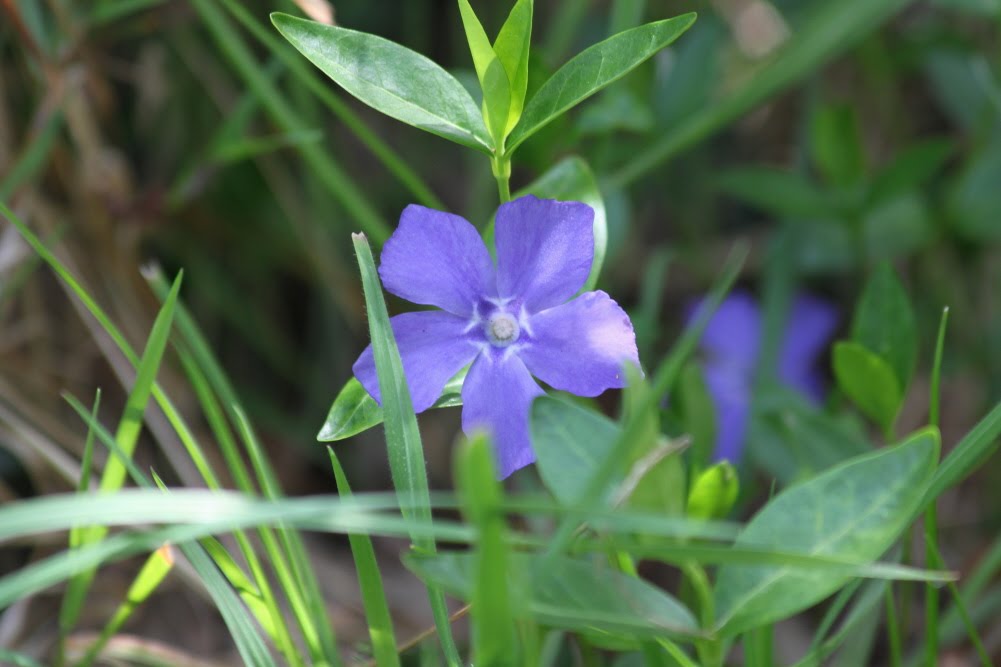
CHAFFINCHJust before the path turns away from the river at the Grove Ferry end I was pleased to hear a sound not heard since last summer, the screeching calls of about half a dozen Swifts flying past overhead. For me this is one of the most evocative sounds of the year which along with the Skylark song, which I heard a few minutes later, conjures up instant pictures in my mind of warm, halcyon summer days. Their visit unfortunately is all too short and they will depart as 'swiftly' as they arrived by the end of August or very early September, and who can blame them. Here also I noticed the plant below growing beneath the hedgerow. I think it's Lesser Periwinkle, please let me know if i'm wrong.
 LESSER PERIWINKLE
Butterflies were few and far between today surprisingly, a few Peacocks on the wing as ever, still looking a bit ragged as below and I did see a few Green Veined Whites but they weren't inclined to let me take their picture, always dashing past as if late for some very important meeting somewhere.
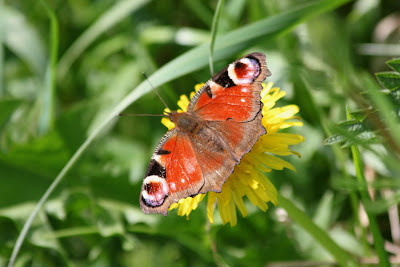 PEACOCK
From the viewing mound I could see that the adjacent paddocks were host to Crows, Jackdaws a few Rooks and a Green Woodpecker but not much else. The pools also were virtually uninhabited, only the reedbeds showed signs of avian presence, from where the incessant chatter of Reed Warblers and Sedge Warblers emanated but only one solitary Sedge was brazen enough to show himself on the top of a small Hawthorn bush.
The David Feast hide aka the Green hide was equally disappointing with just two Common Terns (below) a sleeping Greylag Goose and a Moorhen to entertain me. Although I was pleased to see the first of many Hobbys fly over the hide and also one of about five Marsh Harriers also float by.
 COMMON TERNS
As I made my way to the Marsh hide I noticed lots of small shiny beetles along the side of the ditches (below). Since getting home I think I have identified them as Mint Leaf Beetles but again i'm happy to be corrected if necessary!
 MINT LEAF BEETLES
I was also very pleased to see five more Hobbys all in the air together close to the Marsh hide. I managed to get a couple of action shots, not brilliant but they'll do. The second one I believe shows the bird feeding on the wing having caught an insect in flight.
 HOBBY
HOBBY HOBBY
HOBBYIt was standing room only in the Marsh hide. I had a quick scan from the back to locate a single Greenshank and a couple of Lapwings and an elderly lady asked me if I could see the bulge in a Heron's neck caused by it just swallowing a Marsh Frog? I replied that I could and suggested that maybe it just had a Frog in it's throat. I then left while the going was good. I was glad that I did actually because once back outside I heard a Bittern booming close by, another first for me. Also this Marsh Harrier soared quite high overhead while I listened.
 MARSH HARRIER
Have you noticed what a spectacular year it is for Dandelions? They are everywhere, presumably something has caused this but I don't know what. All I know is they look much better in the wild than they do in my back lawn.

The sound that greets you at Stodmarsh above almost everything else is the 'singing' of the Marsh Frogs, it's spectacular, it's incessant, it's loud, it's raucous and it eventually gets on your nerves. This is one of the thousands of culprits!
 MARSH FROG
Final bird of the day was this magnificent male Marsh Harrier below, one of about five seen, all males. Presumably the females are now sitting on nests somewhere.
So, no Grasshopper Warbler seen or heard today but the Hobbys were spectacular. A pretty interesting day all round with over 40 species seen.
 MALE MARSH HARRIER
 MARSH FROGS...JUST HANGING OUT


 COMMON LIZARD